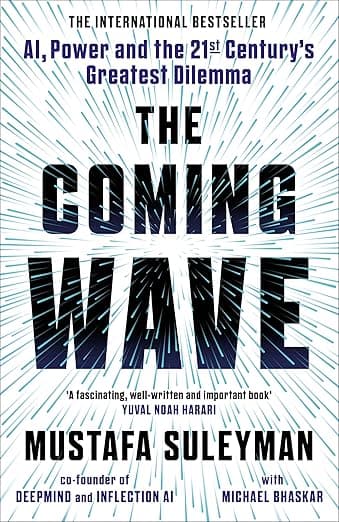
The Coming Wave: The instant Sunday Times bestseller from the ultimate AI insider
Visit Product
100


€ 32
€ 33

25

100 Reviews
93% of buyers have recommeded this.
Current Price

€ 32
Average Price

€ 24
Highest Price

€ 32
Lowest Price

€ 19
Product Description
Books›Textbooks & Study Guides›Medicine & Health SciencesTo view this video download Flash Player5 star4 star3 star2 star1 star5 star53%28%13%3%3%53%5 star4 star3 star2 star1 star4 star53%28%13%3%3%28%5 star4 star3 star2 star1 star3 star53%28%13%3%3%13%5 star4 star3 star2 star1 star2 star53%28%13%3%3%3%5 star4 star3 star2 star1 star1 star53%28%13%3%3%3%var metricsName = "DesktopCredibleBadgesInTopReviewsDetailPageCount" if(window.ue) { ue.count(metricsName, 0) } <img src="https://m.media-amazon.com/images/S/amazon-avatars-global/default.png"/>moglodyte5.0 out of 5 stars China will win the AI race, if we let it Reviewed in Germany on 3 December 2023Verified Purchase There is no doubt that this book, by the founder of DeepMind, will be influential for years to come. There is much for policy makers to dwell upon. The style of writing is accessible, there are no equations, nor are we expected to understand the sublime complexities of multi-layered neural networks which apparently give DeepMind its ‘mind’. The twin topics of the book are artificial intelligence and synthetic biology, how they combine to make the future not only exciting but threatening. The book concludes with a list of ways in which we can reduce that threat.Throughout the book there is a lurking presence and it is China. The author mentions the adversarial posture that the West has taken towards China’s technological progress, such as restricting the sale of advanced AI-capable chips, but I was disappointed that this was not explored further as it has huge consequences for the policies of ‘containment’ listed at the end of the book. China will go its own way, as Xi Jinping has said it will, while the West may go more slowly as it tries to implement those policies. This requires more thought.Many of us watched the ‘game-changing’ match between AlphaGo and South Korean world champion Lee Sedol in 2016. Less well known is that the match was repeated in 2017 in China with the top Chinese Go player Ke Jie, which is described on page 118 as follows: “The environment was stricter, more controlled; the narrative closely curated by the authorities. No more media circus. The subtext was clear: this wasn’t just a game anymore. AlphaGo won again, but did so amid an unmistakably tense atmosphere.” It wasn’t so much a game this time as a humiliation and its significance was not lost on the Chinese government: “Today, China has an explicit national strategy to be the world leader in AI by 2030. The New Generation Artificial Intelligence Development Plan, announced just two months after Ke Jie was beaten by AlphaGo, was intended to harness government, the military, research organizations, and industry in a collective mission.”One of the declared goals of that mission is “making China the world’s primary innovation center” (quote from the Chinese plan). The book goes on to remind us that “China overtook the United States in number of PhDs produced in 2007, but since then investment in and expansion of programs have been significant, producing nearly double the number of STEM PhDs as the United States every year” (p121). And what is the West doing? Allowing its universities to steadily undermine their pre-eminence in science by anti-science ‘woke’ agendas. It’s mad. Although China’s relentless technological advance is not the main theme of the book, for me it is the most important take-away for policy makers. The implications for the free world are ominous if it doesn’t get its act together pretty quickly. China will read this book with interest. So should our leaders. Read more 10 people found this helpful Helpful Reportvar metricsName = "DesktopCredibleBadgesInTopReviewsDetailPageCount" if(window.ue) { ue.count(metricsName, 0) } <img src="https://m.media-amazon.com/images/S/amazon-avatars-global/default.png"/>Parsec4.0 out of 5 stars Sind wir vorbereitet auf das, was womöglich kommt? Reviewed in Germany on 13 July 2024Verified Purchase Ich halte THE COMING WAVE von Mustafa Suleyman nicht nur für ein sehr gut geschriebenes, sondern auch für ein enorm wichtiges Buch.Der Grund ist sehr einfach: es dürfte nicht zu übersehen sein, dass die gesamte Menschheit gegenwärtig an einem technologisch bedingten Scheideweg steht – künstliche Intelligenz (KI) beginnt, immer mehr Teil unseres Alltags zu werden, breitet sich mit ungeahnter Geschwindigkeit aus, und entwickelt sich dabei stetig weiter. Bei all dem ist KI auch noch ein sehr bedeutsamer Treiber und unschätzbares Hilfsmittel für zahlreiche andere Wissenschaftsgebiete, wie z.B. Bio- und Gentechnik, welcher hiermit ganz neue Möglichkeiten eröffnet werden. Hinzu kommt, dass der Einfluss von KI eben nicht nur technologisch, sondern eben auch gesellschaftlich, ökonomisch und politisch bereits jetzt beträchtlich ist, und sich dies aller Wahrscheinlichkeit in den kommenden Jahren noch deutlich steigern wird - KI und die sich aus KI ergebenen Konsequenzen können schon in sehr naher Zukunft für enorme und kaum absehbare Umwälzungen sorgen.Kurz und gut: die gegenwärtig (2024) anrollende, nächste technologische Welle bietet ganz enormes Potential – aber auch beträchtliche Risiken, über die man sich rechtzeitig Gedanken machen muss.Mustafa Suleyman argumentiert kenntnisreich und leidenschaftlich dafür, dass wir KI nicht bloß als „weitere Technologie“ sehen dürfen, sondern uns ihres transformatorischen Potentials und auch den damit einhergehenden Gefahren bewusst sein müssen – die Veränderungen, welche diese Technologie womöglich in nur wenigen Jahren bewirken könnte, sind enorm, und laut Suleyman ohne vorherige Sicherheitsmaßnahmen ab einem gewissen Punkt weder beherrschbar noch prognostizierbar… und die Folgen könnten im worst case für die gesamte Menschheit gravierend sein.Für den Autor gibt es gegenwärtig nur eine sinnvolle Strategie, der neuen technologischen Wellen zu begegnen, ohne sie zu verteufeln, aber auch ohne ihre Risiken zu ignorieren: man muss sie an den richtigen Stellen eindämmen – und zwar so, dass sie im positiven Sinne noch nutzbar ist, aber ohne, dass sie zu einer kaum kalkulierbaren Gefahr für alle wird. Dieses Vorhaben resultiert ohne Frage in einem mehr als komplexen Dilemma, umso wichtiger ist es nach Auffassung des Autors, dieses Thema wirklich ernst zu nehmen und es nicht zu ignorieren. Nach Ansicht des Autors steht, positiv wie negativ, sehr viel (und vielleicht sogar: alles) auf dem Spiel, und die Frage nach der Eindämmung und Kontrolle der kommenden Welle ist für ihn der Dreh- und Angelpunkt.Bei all dem sei betont: der Autor von THE COMING WAVE ist alles andere als ein Phantast oder durchgeknallter Verschwörungstheoretiker. Mustafa Suleyman darf, alleine schon aufgrund seiner Biographie und der Tatsache, dass er einer der Mitgründer der wegweisenden Firma DeepMind ist, vielmehr als ausgewiesener Experte auf dem Gebiet der KI und ihrer Möglichkeiten gelten – seine Meinung sollte also definitiv Gewicht haben, ob man sich ihr nun anschließt oder nicht. Selbst, wenn man Suleymans Schlussfolgerungen nicht oder nicht in jedem Punkt zustimmt sollte man feststellen, dass hier ein Kenner der Materie und ihrer Gefahren seinen Standpunkt mit guten Argumenten vertritt.Alles in allem: ein leidenschaftliches, interessantes und gut fundiertes Werk über eines der vermutlich wichtigsten Themen der Gegenwart. THE COMING WAVE ist definitiv lesenswert.Ich komme auf gute 4 Sterne mit Tendenz zu 5. Read more 3 people found this helpful Helpful Report Translate review to Englishvar metricsName = "DesktopCredibleBadgesInTopReviewsDetailPageCount" if(window.ue) { ue.count(metricsName, 0) } <img src="https://m.media-amazon.com/images/S/amazon-avatars-global/default.png"/>GSMUC5.0 out of 5 stars Reale Vorrausschau Reviewed in Germany on 21 October 2024Verified Purchase Keine brauchbare tolle gehypte Entwicklung ohne massive Nebenwirkungen. Wobei der Adressat von Vorteilen nicht gleich dem Adressaten der Nachteile sein müssen. Read more Helpful Report Translate review to Englishvar metricsName = "DesktopCredibleBadgesInTopReviewsDetailPageCount" if(window.ue) { ue.count(metricsName, 0) } <img src="https://m.media-amazon.com/images/S/amazon-avatars-global/default.png"/>Kunde3.0 out of 5 stars Sehr einseitige, aber insgesamt interessante Betrachtung Reviewed in Germany on 28 May 2024Verified Purchase Dass der Autor ein glühender Verfechter der positiven Aspekte von KI ist, merkt man schon in den ersten Sätzen und auch für den Rest des Buchs werden praktisch ausschließlich positive Superlative benutzt.Das Konzept der "Wellen" im Bereich Technologien ist nur eine andere Benennung für ausreichend beschriebene Phänomene, wenn sich mehrere technologische Entwicklungen gegenseitig beeinflussen und verstärken, insbesondere fundamentale Entdeckungen wie Dampfkraft.Mir ist das Buch persönlich zu unreflektiert geschrieben und das ständige Wiederholen der immer gleichen Lobgesänge wird spätestens nach 2, 3 Kapiteln langweilig.Trotz der zweifellos großen Umwälzungskraft von KI ist Stand heute nicht ausgemacht, ob die bisherigen Modelle überhaupt zukunftsfähig sind. Auf ihre vielen vorhandenen Schwachstellen wird kaum eingegangen, dafür soll die 'nerdige' KI-Ecke lieber öffentlichkeitswirksam in Verbindung zu "menschlichen" Wissenschaften wie Biologie gebracht werden. Diese Zusammenhänge existieren zweifellos (Beispiel KI zur Diagnose von Muttermalen), fallen aber eher unter Nutzung eines Werkzeugs als in den Bereich "KI-Unternehmen sind philantrophisch", wie uns das Buch weismachen will.Ich selbst bin ein großer Bewunderer von KI-Systemen, jedoch müssen die Risiken und Limitierungen ebenso stark bedacht werden wie der Nutzen. Das geschieht in "The Coming Wave" eindeutig nicht. Read more 8 people found this helpful Helpful Report Translate review to Englishvar metricsName = "DesktopCredibleBadgesInTopReviewsDetailPageCount" if(window.ue) { ue.count(metricsName, 0) } <img src="https://m.media-amazon.com/images/S/amazon-avatars-global/default.png"/>Robert Boehm5.0 out of 5 stars Differenziert und weitsichtig Reviewed in Germany on 5 November 2024Verified Purchase sehr lesenswert. Read more Helpful Report Translate review to Englishvar metricsName = "DesktopCredibleBadgesInTopReviewsDetailPageCount" if(window.ue) { ue.count(metricsName, 0) } <img src="https://m.media-amazon.com/images/S/amazon-avatars-global/f5c90b58-7681-45a8-8b5c-876c60fdd312._CR100%2C0%2C299%2C299_SX460_.jpg"/>Book Shark5.0 out of 5 stars Thought-provoking Reviewed in the United States on 15 May 2024Verified Purchase The Coming Wave: Technology, Power, and the Twenty-first Century’s Greatest Dilemma by Mustafa Suleyman“Mustafa Suleyman” examines the future of Artificial Intelligence (AI): the good, the bad and the scary in realistic terms. Co-founder and CEO of Inflection AI and cofounder of DeepMind, Mustafa Suleyman takes the readers on a ride to the future of AI and its implications. This thought-provoking 500-page book includes fourteen chapters broken out by the following four parts: I. Homo Technologicus, II. The Next Wave, III. States of Failure, and IV. Through the Wave.Positives:1. Well-researched an insightful book. Suleyman has the expertise and experience to write such a book.2. Artificial Intelligence (AI) is a fascinating topic, specifically whether containment is possible.3. The book flows very well and it’s accessible. The reader is not expected to have expertise in the area to understand it.4. Clearly defines the key topic of the book, the wave. “So, what is a wave? Put simply, a wave is a set of technologies coming together around the same time, powered by one or several new general-purpose technologies with profound societal implications.”5. Goes over the history of technological waves. “One major study pegged the number of general-purpose technologies that have emerged over the entire span of human history at just twenty-four, naming inventions ranging from farming, the factory system, the development of materials like iron and bronze, through to printing presses, electricity, and of course the internet. There aren’t many of them, but they matter; it’s why in the popular imagination we still use terms like the Bronze Age and the Age of Sail.”6. Defines the most important topic in the book, containment. “Containment is the overarching ability to control, limit, and, if need be, close down technologies at any stage of their development or deployment.” “Technical containment refers to what happens in a lab or an R&D facility. In AI, for example, it means air gaps, sandboxes, simulations, off switches, hard built-in safety and security measures—protocols for verifying the safety or integrity or uncompromised nature of a system and taking it offline if needed.”7. The two technologies threatening to surpass our own intelligence. “The coming wave of technology is built primarily on two general-purpose technologies capable of operating at the grandest and most granular levels alike: artificial intelligence and synthetic biology.”8. Describes breakthroughs in AI. “The breakthrough moment took nearly half a century, finally arriving in 2012 in the form of a system called AlexNet. AlexNet was powered by the resurgence of an old technique that has now become fundamental to AI, one that has supercharged the field and was integral to us at DeepMind: deep learning.”9. Interesting observations and predictions. “In the words of an eminent computer scientist, “It seems totally obvious to me that of course all programs in the future will ultimately be written by AIs, with humans relegated to, at best, a supervisory role.”10. The often-used term Singularity defined. “Over the last decade, intellectual and political elites in tech circles became absorbed by the idea that a recursively self-improving AI would lead to an “intelligence explosion” known as the Singularity.”11. Examines synthetic biology. “Companies such as DNA Script are commercializing DNA printers that train and adapt enzymes to build de novo, or completely new, molecules. This capability has given rise to the new field of synthetic biology—the ability to read, edit, and now write the code of life.”12. Looks at other transformative technologies that are part of the wider wave. “Amazon’s “first fully autonomous mobile robot,” called Proteus, can buzz around warehouses in great fleets, picking up parcels. Equipped with “advanced safety, perception, and navigation technology,” it can do this comfortably alongside humans. Amazon’s Sparrow is the first that can “detect, select, and handle individual products in [its] inventory.””13. Describes the quest for quantum supremacy. “In 2019, Google announced that it had reached “quantum supremacy.” Researchers had built a quantum computer, one using the peculiar properties of the subatomic world.”14. Describes the four features that define the coming wave. “The coming wave is, however, characterized by a set of four intrinsic features compounding the problem of containment. First among them is the primary lesson of this section: hugely asymmetric impact. You don’t need to hit like with like, mass with mass; instead, new technologies create previously unthinkable vulnerabilities and pressure points against seemingly dominant powers.”15. Explores containment issues. “However, any discussion of containment has to acknowledge that if or when AGI-like technologies do emerge, they will present containment problems beyond anything else we’ve ever encountered. Humans dominate our environment because of our intelligence. A more intelligent entity could, it follows, dominate us.”16. The race for AI supremacy between China and the U.S. “China is already ahead of the United States in green energy, 5G, and AI and is on a trajectory to overtake it in quantum and biotech in the next few years. The Pentagon’s first chief software officer resigned in protest in 2021 because he was so dismayed by the situation. “We have no competing fighting chance against China in 15 to 20 years. Right now, it’s already a done deal; it is already over in my opinion,” he told the Financial Times.”17. Statements that resonate. “Science has to be converted into useful and desirable products for it to truly spread far and wide. Put simply: most technology is made to earn money.”18. Examines the implications of this coming wave and democracy. “A meta-analysis published in the journal Nature reviewed the results of nearly five hundred studies, concluding there is a clear correlation between growing use of digital media and rising distrust in politics, populist movements, hate, and polarization.”19. Cyber threats examined. “Today’s cyberattacks are not the real threat; they are the canary in the coal mine of a new age of vulnerability and instability, degrading the nation-state’s role as the sole arbiter of security.”20. The dangers of highest of high tech in the hands of a few. “This raises the prospect of totalitarianism to a new plane. It won’t happen everywhere, and not all at once. But if AI, biotech, quantum, robotics, and the rest of it are centralized in the hands of a repressive state, the resulting entity would be palpably different from any yet seen.”21. Describes varieties of catastrophe. “AI is both valuable and dangerous precisely because it’s an extension of our best and worst selves.”22. Describes keys to containment. “Deft regulation, balancing the need to make progress alongside sensible safety constraints, on national and supranational levels, spanning everything from tech giants and militaries to small university research groups and start-ups, tied up in a comprehensive, enforceable framework.”23. Defines the key problem of the twenty-first century. “The central problem for humanity in the twenty-first century is how we can nurture sufficient legitimate political power and wisdom, adequate technical mastery, and robust norms to constrain technologies to ensure they continue to do far more good than harm.”24. Lists the ten steps to containment. “There’s a clear must-do here: encourage, incentivize, and directly fund much more work in this area. It’s time for an Apollo program on AI safety and biosafety.”25. Notes and a link to the bibliography provided.Negatives:1. If you have watched Suleyman’s YouTube Videos there is very little new here.2. Emphasis of speculation over technical details. I wanted more details; if the purpose is to keep the book accessible such details can be included in an appendix.3. Redundancy.4. Lack visual supplementary material: charts, diagrams, and sketches to complement the narrative.5. Lacks a formal bibliography.In summary, this is an important topic a plea of sorts to global leadership and subject matter experts to watch this issue carefully and to take the proper precautions to contain the worst of AI’s potential. Suleyman makes clear that AI has potential for much good but also to catastrophe if humanity loses containment. The Coming Wave of AI and synthetic biology creates immense challenges for humanity, are we ready for it? An excellent, provocative book. I highly recommend it!Further suggestions: “Superintelligence” by Nick Bostrom, “The Age of AI” by Matt Ridley, “AGI: Age of Superintelligence” by Richard A. Mann,“The Singularity Is Near” and “How to Create a Mind” by Ray Kurzweil, “Our Final Invention” by James Barrat, “Surviving AI” by Calum, “ Chace, “When Computers Can Think” by Anthony Berglas, “What to Think About Machines That Think” edited by John Brockman, and “Rise of the Robots” by Martin Ford. Read more Reportvar metricsName = "DesktopCredibleBadgesInTopReviewsDetailPageCount" if(window.ue) { ue.count(metricsName, 0) } <img src="https://m.media-amazon.com/images/S/amazon-avatars-global/default.png"/>Alexandre5.0 out of 5 stars Uma jornada de compreensão geopolítica, econômica e social dos impactos das novas tecnologias Reviewed in Brazil on 15 March 2024Verified Purchase Os autores se esmeraram em proporcionar ao leitor uma análise realmente multifacetada do que realmente está por trás de tecnologias convergentes, onde, sem dúvida alguma a IA tem uma espécie de papel central, como indutor de ouras como as biotecnologias e computação quântica. Apesar do cenário meticulosamente construído de forma aterradora em dados momentos, considero essencial conhecer a grande sobreposição de ondas tecnoeconômicas (ao estilo Carlota Perez) que estão por erodir ainda mais, as fronteiras das nações, privacidade e democratização do acesso a tecnologias com potencial tão profundo. Não é um livro de tecnicalidades. Vale a pena, apesar de soar um pouco repetitivo no argumento global do livro e de poder ser percebido como um continuum do livro do fórum econômico mundial que toca no mesmo diapasão. Read more Report Translate review to Englishvar metricsName = "DesktopCredibleBadgesInTopReviewsDetailPageCount" if(window.ue) { ue.count(metricsName, 0) } <img src="https://m.media-amazon.com/images/S/amazon-avatars-global/default.png"/>Great book5.0 out of 5 stars Great book Reviewed in Mexico on 8 November 2023Verified Purchase An actualist book about futher technology Read more Reportvar metricsName = "DesktopCredibleBadgesInTopReviewsDetailPageCount" if(window.ue) { ue.count(metricsName, 0) } <img src="https://m.media-amazon.com/images/S/amazon-avatars-global/default.png"/>Peter5.0 out of 5 stars A wake-up call to the coming world Reviewed in Canada on 7 September 2023Verified Purchase Mustafa Suleyman tackles the questions swirling around powerful new technologies like AI head on. It’s a compelling read (I couldn't put it down after I started). While it makes big claims it is always thorough about building the case and marshaling the evidence (there are nearly 30 pages of notes and references). The writing is rooted in his personal experience as an AI entrepreneur, and is both a wake-up call to the coming world and an in-depth analysis of what is happening right now. Highly recommended. Read more Reportvar metricsName = "DesktopCredibleBadgesInTopReviewsDetailPageCount" if(window.ue) { ue.count(metricsName, 0) } <img src="https://m.media-amazon.com/images/S/amazon-avatars-global/3fbdb83e-d9a0-40a0-af65-cea0d1e9b887._CR0%2C0%2C500%2C500_SX460_.jpg"/>Rajiv Chopra5.0 out of 5 stars Excellent. Disturbing. Balanced. Reviewed in India on 24 November 2024Verified Purchase Mustafa Suleyman and Michael Bhaskar have written an excellent book, "The Coming Wave." Unlike many authors who project unbridled optimism, the authors strike two notes simultaneously: one of inevitability and the other of caution and concern.They divided the book into four sections, which they call 'Homo Technoligicus,' 'The Next Wave,' 'States of Failure,' and 'Through the Wave.'They devote the first section to explaining how waves of technological innovation have transformed humanity for thousands of years. Even the slightest pause will convince anyone of this truism. Since we fashioned stone tools centuries ago, humans have innovated, changing the world and society.The next wave will create changes at an exponential rate, a topic they discuss. When I was a child, we did not possess direct dialing telephones, and now the mobile phone often appears to extend our brains. They discuss artificial intelligence and its impact–now and in the future. A person growing up now will live a different life than we do today. When will machine intelligence overtake human intelligence? Most people cannot perform the most straightforward calculations and resort to a calculator. No one knows of Trachtenberg's system of speed mathematics anymore!The book's third section focuses on the dangers of this advancing wave of technology: misinformation, disinformation, cyberwar, and the changing nature of war, amongst others. Yet, as the authors emphasize, technological advances are improving our lives–at least, the lives of those with access to the benefits. Technology does not benefit a starving person.Unlike most authors who present us with an overtly sunny view of these advancements, Mustafa Suleyman and Michael Bhaskar acknowledge that the sunlight warms us but can also burn us. The book's fourth section focuses on the necessity for responsible containment. It proposes ten steps (or means) by which governments, society, and corporations can work together to contain the dangers this new 'machine technology' poses to society while retaining the benefits.They end with a provocative question: how will the nature and meaning of humanity change in the coming decades?The book is excellent, well-written, and accessible to everyone, including the lay reader. It is a book that many people must read to educate themselves on current and future developments in AI and synthetic biology. People must read the book now. In five years, it will be outdated. Read more Report
Similar Products